
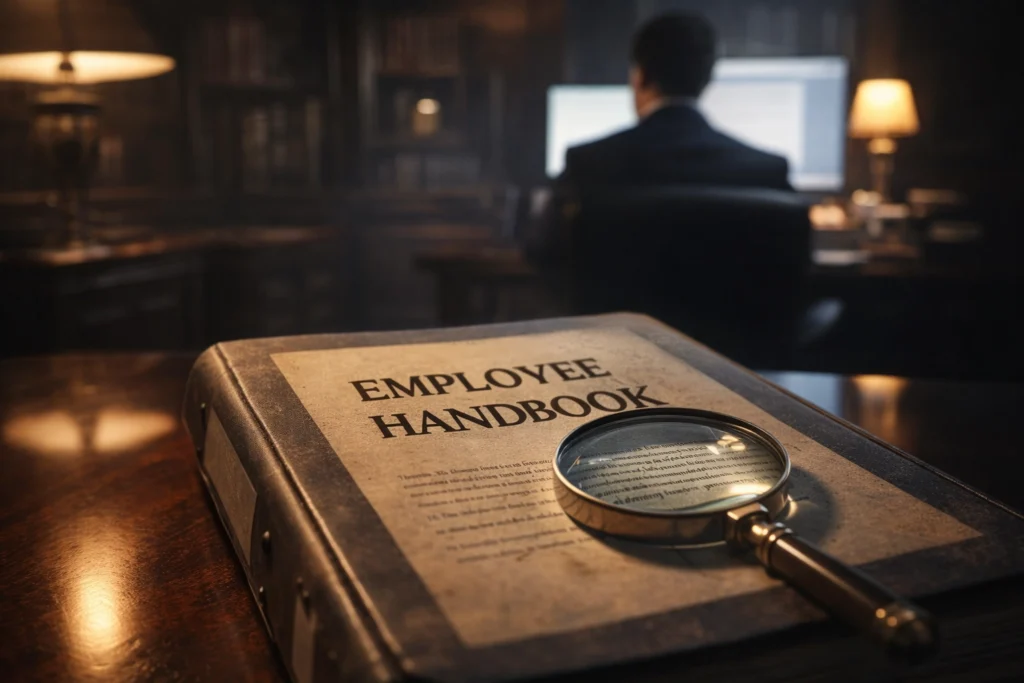
In the spring of 2025, a mid-sized HVAC and plumbing contractor, we’ll call them Industrial Pipe & Flow, found itself in the crosshairs of a Department of Labor (DOL) audit. The company, which had grown steadily to 42 employees, operated with a sense of familial trust. Their employee handbook, a 40-page document purchased from an online template site in 2019, sat in a digital folder, largely untouched and rarely referenced.
The crisis began not with a grand structural failure, but with a single disgruntled dispatcher. Following a termination for repeated performance issues, the former employee’s attorney did not just challenge the firing; they subpoenaed the entire employee handbook.
Upon review, the attorney identified a “goldmine” of non-compliance. The handbook contained outdated language regarding rest breaks that didn’t account for new state-specific mandates. It lacked a clear policy on the use of personal devices and Artificial Intelligence (AI) in the workplace: tools the dispatcher had used daily. Most critically, the “at-will” disclaimer was buried and poorly phrased, providing a crack in the door for a wrongful termination claim.
What began as a routine personnel matter escalated into a six-figure legal battle and a comprehensive federal audit. The moral was clear: an outdated handbook is not just a neglected document; it is a liability waiting to be exploited.
The Plaintiff’s Attorney: Your Handbook is Their Roadmap
When a business faces an employment lawsuit, the plaintiff’s attorney has a specific objective. They are not looking for your “good intentions” or your “company culture.” They are looking for indications of destroying at-will employment, a violation of statutory rights, or an inconsistency in policy application.
A flawed handbook serves as a roadmap for litigation. If your policy states that an employee will receive a written warning before termination, but you fire someone for a first-time offense without documenting a policy exception, you have created a “due process” argument for the plaintiff.
Attorneys look for “legal trapdoors” including:
- Vague Harassment Reporting: If the reporting chain is unclear, lists a retired manager, or reports to the same person the employee has an issue with, the company fails to meet its obligation.
- Unlawful Confidentiality Clauses: Policies that broadly prohibit employees from discussing “wages or working conditions” violate the National Labor Relations Act (NLRA).
- Outdated Wage and Hour Sections: Failure to address remote work expenses or “off-the-clock” work in 2026 is an invitation for a class-action wage claim.

The 2026 Landscape: Why “Last Year” Isn’t Good Enough
The regulatory environment of 2026 has introduced complexities that were non-existent even two years ago. For small businesses in the pet care, trades, and restaurant sectors, the risks are particularly acute due to high turnover and mobile workforces.
The Rise of AI Policies
As AI tools become integrated into scheduling, routing, and customer service, handbooks must clearly define acceptable use. Failure to disclose the use of AI in monitoring employee performance or in the hiring process can lead to violations of new transparency laws. If your handbook doesn’t mention AI, you are operating in a legal vacuum.
The One Big Beautiful Bill (OBBB) Act
Recent federal legislation, such as the OBBB Act, has significantly altered requirements for payroll, benefits, and tip reporting. For restaurant owners, this means that outdated “tip pool” policies in a 2023 handbook are likely now illegal. For trades businesses, the act introduces more stringent overtime provisions that must be explicitly detailed to avoid workplace conflict and regulatory fines.
Pay Transparency and Multi-State Compliance
With more employees working across state lines, whether a technician crossing from Arizona into California or a remote bookkeeper in another time zone, your handbook must account for the broadest applicable law. Many states now require pay bands to be documented and shared upon request. If your handbook still includes “pay secrecy” language, you are in direct violation of current labor standards.
Management Failures: The High Cost of Inaction
Management failures regarding handbooks typically fall into three categories: the “Template Trap”, “Policy-Practice Divergence”, or “Risky Documentation.”
The “Template Trap” occurs when a business owner buys a generic handbook to “check a box.” These documents are rarely state-specific and never industry-specific. A plumbing company has different safety and equipment needs than a pet grooming salon. Using a generic document leaves massive gaps in safety protocols and industry-specific compliance.
“Policy-Practice Divergence” is perhaps more dangerous. This occurs when the handbook says one thing, but managers do another. If the handbook mandates paid time off benefits after 90 days but managers are telling new hires they receive it upon hire, the handbook is effectively neutralized in a courtroom. These inconsistencies are exactly what we identify during our HR health checks.
“Risky Documentation” is a related failure because documentation is incomplete or non-existent. When performance issues, policy exceptions, discipline, accommodations, and compensation decisions are not documented, management loses the ability to show that decisions were lawful, consistent, and business-related. In an investigation or lawsuit, missing records are often treated as evidence of poor internal controls.
Employee records can also create liability when they contain information that should not be there. Notes that reference protected characteristics, medical details, assumptions about age, pregnancy, disability, national origin, or other legally protected statuses can violate discrimination laws and undermine the employer’s defense. The same is true when personnel files show employees were treated differently for similar conduct without a clear, documented explanation for the distinction.
Failure to align these areas leads directly to:
- Increased Legal Fees: Defending a poorly written policy is significantly more expensive than defending a compliant one.
- DOL and NLRB Fines: Regulatory bodies do not accept “I didn’t know the law changed” as a defense.
- Reputational Damage: Being known as an employer with “unfair” or “illegal” policies makes recruiting top-tier talent in the trades or pet care industry nearly impossible.

From Risk to Resilience: Your Path Forward
As a business owner with 25 to 50 employees, you have reached a critical “scaling point.” You are too large to manage through informal handshakes, yet often too small to justify a full-time, in-house HR department. This is where strategic intervention becomes a necessity rather than an option.
You must stop viewing your handbook as a “one-and-done” project. It is a living document that requires annual and sometimes quarterly audits to remain effective. If you have not reviewed your personnel records and handbook within the last 12 months, you are likely operating with a significant compliance blind spot.
The Proactive Solution: The HR Health Check
At Workplace Investigators LLC, we have adopted a unique approach to risk management. We look at your business through the eyes of a plaintiff’s attorney. We don’t just check for typos; we look for the “legal trapdoors” that could sink your business during a lawsuit.
Our HR Health Check is a comprehensive examination of your HR processes. We review your employee handbook and personnel records to identify coaching blind spots and compliance failures before they reach a courtroom. This is not a generic review; it is a customized deep-dive tailored to the trades, pet care, and restaurant industries.
For those who require more consistent support, our fractional services provide the guidance of an employment law expert without the overhead of a full-time executive. We can help you draft a customized handbook, manage employee engagement, and ensure that your managers are actually following the policies you have put in place.
The Moral of the Story: Catch Issues Before They Become Problems
The story of Industrial Pipe & Flow didn’t have to end in a six-figure settlement. Had they conducted a proactive health check a year earlier, they would have caught the outdated rest-break language and clarified their “at-will” status throughout their personnel records and employment documentation. They would have implemented an AI policy that protected their data and their employees.
The cost of a proactive HR audit is a fraction of the cost of a single hour of litigation defense. In the regulatory landscape of 2026, inaction is the greatest financial risk you can take.
Is your business protected or just lucky?
Don’t wait for a DOL audit or a subpoena to find out where your handbook is failing you. Contact Workplace Investigators LLC today to schedule your HR Health Check. Our team will identify your compliance blind spots and help you build a lawsuit-proof foundation for your growth.